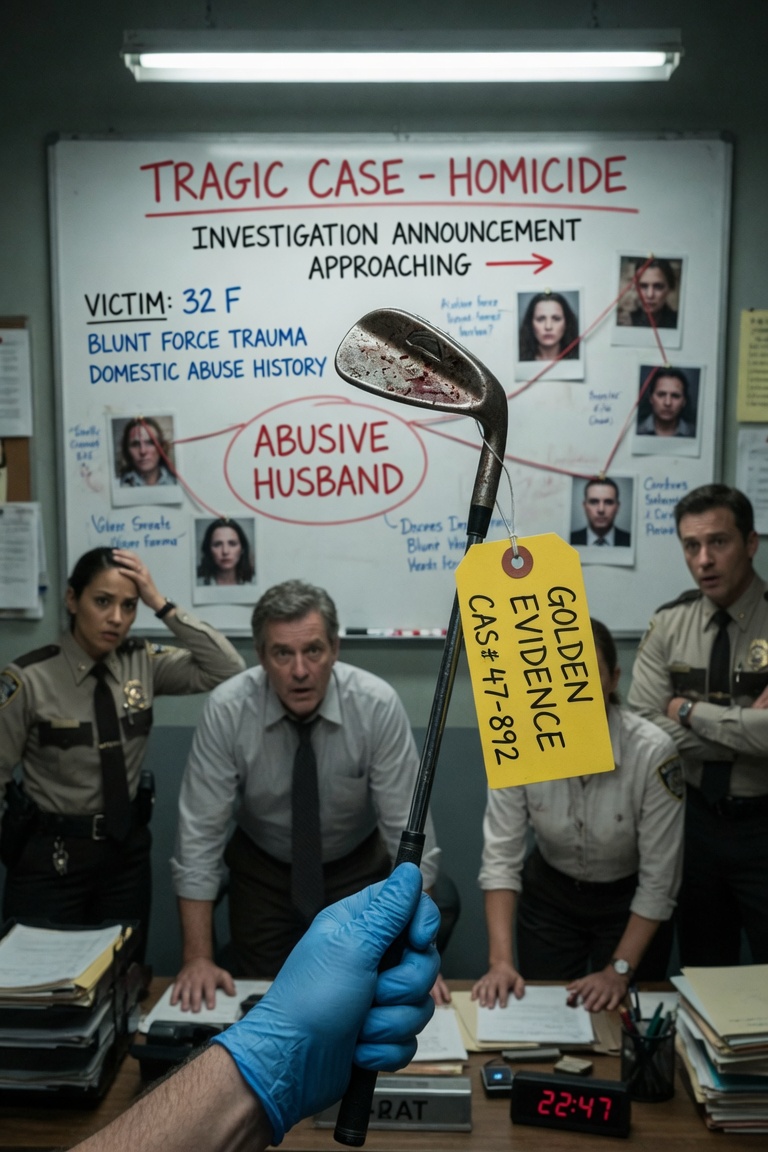
The entire police department was racking its brains as the announcement of the investigation into a tragic case was approaching, when suddenly a golf club became the golden evidence to incriminate the abusive husband!
The Golf Club Clue: How One Piece of Sporting Equipment Threatened to Crack Open a Husband’s Perfect Alibi in His Wife’s Brutal Murder
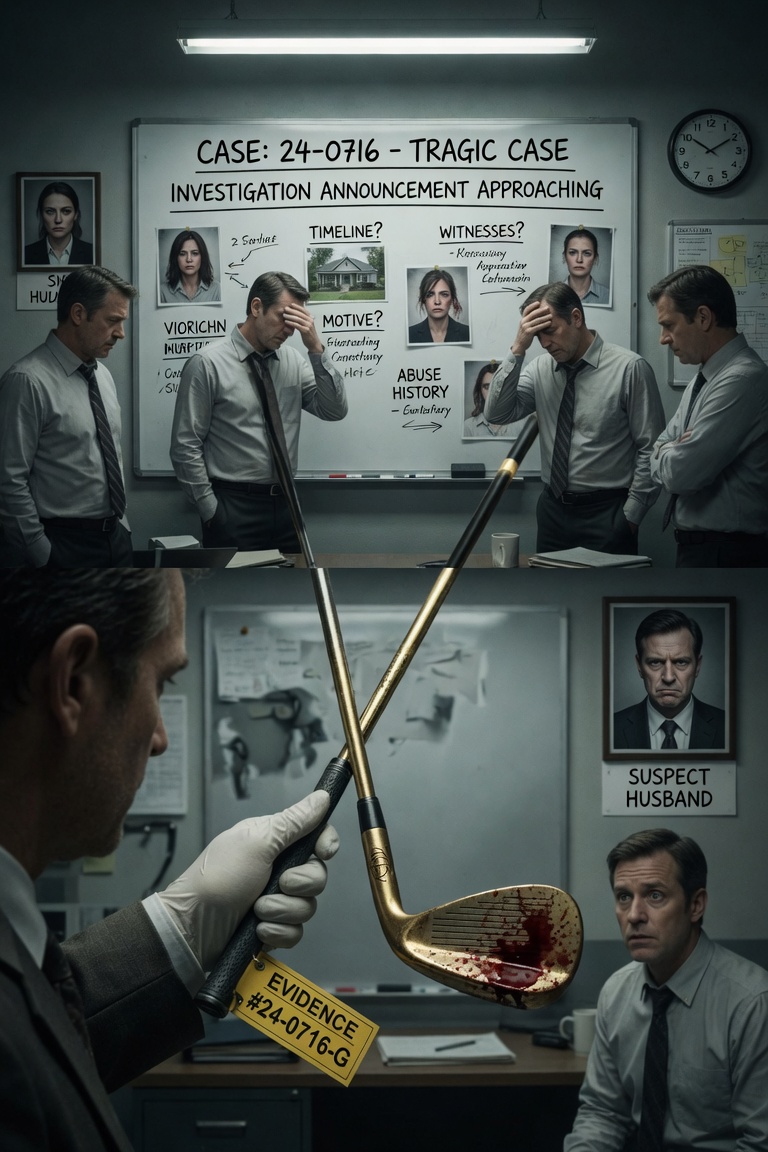
In the high-stakes world of homicide investigations, timing is everything. With just 48 hours until the department’s scheduled press conference announcing findings in the tragic death of 48-year-old Elena Vargas, the entire Central County Police Department was on edge. What began as a presumed accidental fall in the couple’s luxurious backyard had morphed into a swirling vortex of suspicion, lies, and buried secrets. Then, in a stunning late-night breakthrough, a single golf club—scratched, bloodied, and hidden in plain sight—emerged as the golden evidence that could finally charge Elena’s husband, the smooth-talking, golf-obsessed real estate mogul Richard Vargas, with murder.
This is the gripping, still-unfolding detective story that has detectives, forensic experts, and courtroom watchers riveted. A tale of marital betrayal, a despicable husband’s web of deceit, and one piece of sports equipment that may rewrite the entire narrative of a woman’s heartbreaking death.
The Perfect Life That Hid a Nightmare
Elena Vargas was the kind of woman people remembered. Elegant, sharp-witted, and deeply involved in local charities, she had built a successful interior design business alongside her husband’s booming real estate empire. Their sprawling hillside mansion in upscale Riverside Heights featured manicured lawns, a private pool, and a personal nine-hole putting green where Richard spent countless hours perfecting his swing.
To the outside world, the Vargas marriage was aspirational. They vacationed in luxury resorts, posted smiling photos on social media, and were fixtures at country club events. But behind the polished facade, cracks had formed. Friends later told investigators that Elena had grown increasingly frustrated with Richard’s golf addiction and rumored affairs. “She felt invisible,” one close confidante revealed. “He’d spend entire days on the course while she handled everything else.”
On the evening of May 12, 2026, Elena was found at the bottom of the stone stairs leading from their patio to the garden. Her skull was fractured, and there were bruises consistent with a fall. Initial responders noted no signs of forced entry. Richard, who claimed he had been at the golf club all afternoon and evening, returned home to “discover” her body around 10:45 PM. His alibi seemed ironclad—security footage from the club, witness statements from fellow golfers, and his credit card receipts for drinks at the 19th hole.
The preliminary autopsy suggested an accidental death: possible slip on wet steps after a light rain. The case appeared headed for a quiet close. But something didn’t sit right with Detective Laura Mendoza, a 15-year veteran known for her relentless pursuit of the truth. “Too clean,” she told her partner. “No one falls that perfectly without a single defensive wound unless someone made sure of it.”
Mounting Pressure and the Race Against the Clock
As the investigation deepened, the department faced intense scrutiny. Elena’s family, prominent in the local Latino business community, demanded answers. Media outlets began running headlines like “Mansion Mystery: Accident or Foul Play?” With the press conference looming, Captain Harlan Reeves was under orders from the mayor’s office to deliver closure—or at least a credible narrative.
Detectives pored over financial records, revealing Richard’s mounting debts despite his flashy lifestyle. Life insurance policies on Elena totaled over $2.5 million, with Richard as the sole beneficiary. Phone records showed heated arguments in the weeks prior, including one where Elena allegedly threatened to expose Richard’s extramarital activities.
Yet Richard remained cool under questioning. “I loved my wife,” he insisted in recorded interviews. “Golf was my escape, but I always came home to her.” His golf bag, seized early in the investigation, contained a full set of premium clubs, all appearing clean and well-maintained. Forensic teams found no immediate traces of blood or DNA linking them to the scene.
With the clock ticking, the team expanded their search. They re-examined the crime scene with advanced luminol testing and brought in a golf expert to analyze Richard’s playing habits. Nothing. Tension in the precinct was palpable. Detectives worked double shifts, fueled by coffee and determination. “We’re missing something right in front of us,” Mendoza muttered during one late-night briefing.
The Unexpected Breakthrough: The Golf Club That Changed Everything
It was nearly midnight, just 36 hours before the press conference, when a junior forensic technician made the discovery that shifted the case from cold to explosive. While re-cataloging evidence from the Vargas garage—where Richard stored his golf equipment—a seemingly ordinary driver caught attention. Unlike the other clubs, this one had microscopic scratches near the head and faint residue that initial sweeps had missed.
Advanced testing revealed it: trace amounts of Elena’s blood and hair fibers embedded in the grooves, along with soil matching the garden steps. The club’s grip showed smudged fingerprints consistent with Richard’s, though he had claimed the bag hadn’t left the golf club that day.
How did it get there? The driver was part of a limited-edition set Richard had boasted about on social media. Golf club records and caddy statements confirmed he had used a different set that fateful afternoon. This particular club had been “missing” from his bag until investigators found it carefully wiped and returned to the garage rack.
The implications were devastating. Forensic reconstruction suggested the club could have been used to strike Elena from behind, causing the fatal head trauma, before her body was pushed or dragged down the stairs to stage the accident. The angle of the wound matched the club’s head perfectly. Blood spatter patterns, previously dismissed, now aligned with a swinging motion.
Richard’s alibi began to crumble under scrutiny. Cell phone tower data placed his phone near the mansion earlier than he admitted, and a neighbor’s security camera captured a car resembling his leaving the property around 8 PM—well before the supposed discovery time.
Detective Mendoza confronted Richard in a marathon interrogation. “That golf club tells a different story, Mr. Vargas. The one where you came home early, argued, and ended it with one swing.” Richard’s composure finally cracked. He demanded a lawyer but not before uttering a telling phrase: “It was never supposed to go this far.”
Unraveling the Despicable Husband’s Web of Lies
Richard Vargas, once the charming face of upscale property deals, now stood accused of being a cold, calculating killer. Investigators uncovered a darker pattern. Multiple women came forward with stories of affairs, financial manipulation, and emotional abuse. Elena had apparently consulted a divorce attorney two weeks before her death, preparing to cut Richard out of the business she had helped build.
The golf obsession wasn’t just a hobby—it was Richard’s cover. He used course time to meet mistresses and conduct shady deals. Bank records showed large cash withdrawals coinciding with golf tournament weekends. The “wicked” twist? Elena had begun tracking his movements, perhaps confronting him that night with evidence of infidelity.
The golf club itself became a symbol of irony. The very instrument of Richard’s escape and status had become the weapon that could seal his fate. Forensic golfers consulted on the case noted how the club’s weight and balance made it a plausible improvised weapon—silent, familiar to the suspect, and easily cleaned.
As evidence mounted, the department prepared to charge Richard with first-degree murder, insurance fraud, and staging a crime scene. The press conference was set to announce not closure, but an arrest.
Lingering Questions and the Shadow of Doubt
Yet even as the case against Richard Vargas appears overwhelmingly strong, the story refuses to reach a tidy conclusion. The open questions keep seasoned detectives awake at night.
Was the golf club truly the murder weapon, or could it have been planted by someone with access to the property—perhaps a jealous mistress or a business rival? The blood evidence, while compelling, was minimal. Advanced DNA testing is still pending full results, and contamination concerns linger in high-profile cases.
Elena’s family remains divided. Some believe Richard is guilty; others wonder if Elena’s own stress led to an accidental fall, with the club evidence twisted by overzealous investigators under public pressure.
Richard’s legal team has already signaled a fierce defense, claiming the club was tampered with and pointing to inconsistencies in the timeline. “My client is a golfer, not a killer,” his attorney stated. “This so-called golden evidence is fool’s gold.”
Then there’s the most haunting element: a cryptic note found in Elena’s planner dated the day of her death—“Confront R. about the 7th hole lie.” What did it mean? Was there a witness on the golf course that afternoon who hasn’t come forward? Or does it point to a larger conspiracy involving Richard’s shady associates?
As the department prepares its announcement, the golf club sits in an evidence locker, its scratched metal surface reflecting the harsh fluorescent lights. It has transformed from a simple sports accessory into a silent witness that could either deliver justice or expose flaws in the entire investigation.
The Human Cost and Broader Implications
Beyond the courtroom drama, Elena Vargas’s death highlights deeper societal issues: the isolation many spouses feel in seemingly successful marriages, the dangers of financial dependence, and how obsessions—like golf—can mask deeper character flaws. Relationship experts note that “golf widow” stories often mask control and neglect that can escalate dangerously.
For the Central County Police, this case tests the limits of forensic science and investigative intuition. One overlooked piece of sporting gear nearly allowed a potential murderer to walk free. In the age of perfect alibis and digital trails, sometimes the oldest tools provide the clearest answers.
The press conference is scheduled for tomorrow morning. Will Richard Vargas be led away in handcuffs, the golf club evidence sealing his fate? Or will new revelations cast doubt on everything investigators thought they knew?
The story remains unfinished. Elena Vargas deserved better than a tragic end on her own stairs. Her husband, the man who lived for the game, now finds himself trapped in a far deadlier one—where the final hole may lead straight to prison.
Or perhaps, to an even more shocking twist.